
Ayon Iris Streamer – Hifi-Statement Review – September 2026, Germany
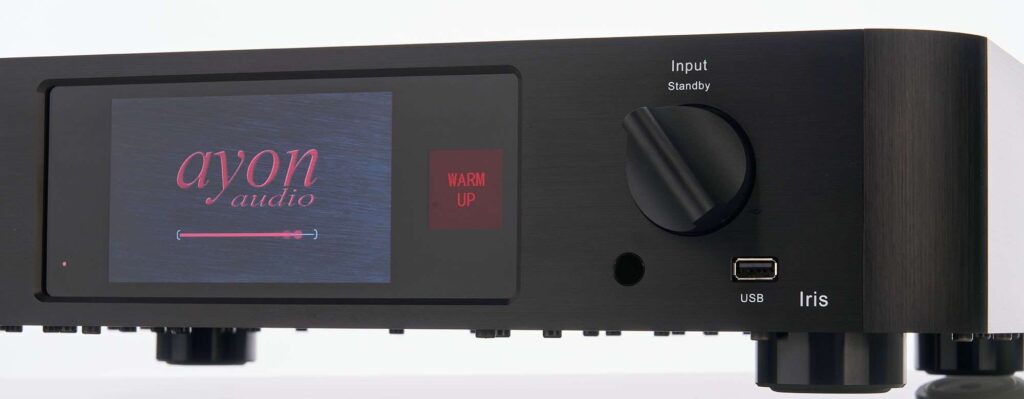
Ayon Iris Signature Streamer
Link to the original German review
September 1, 2026 // Roland Dietl
At High End Vienna, Dirk Sommer and I discovered the Ayon Iris for the first time—and now this extraordinary streaming player is already here for review. The Iris is so new that even its Roon certification was still in progress at the time of testing.
Brand-new though it may be, the Iris certainly did not come out of nowhere. Anyone who has followed the development of Ayon’s digital components will recognize the company’s continuous involvement with streaming. We have been able to follow this evolution as well—after the S3 and S10, we most recently reviewed the S10 II. That makes it all the more interesting to see what roughly two decades of experience with digital technology and streaming have contributed to the Iris.
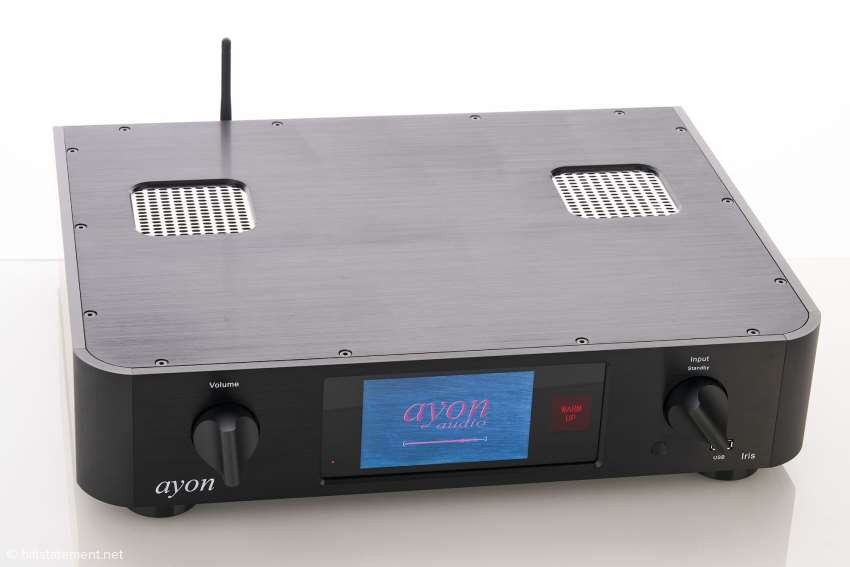
The Ayon Iris from the front—an unmistakably elegant appearance
As Gerhard Hirt explained to me, the Iris incorporates the experience Ayon has accumulated with digital technology in general and streaming in particular over the past 15 to 20 years. Yes, you read that correctly: although Ayon is best known for its first-class tube equipment, the Austrian manufacturer has never shied away from streaming. As early as 2012, Ayon published a noteworthy “Guide to Building an Infrastructure for Network Players.”
Let’s take a closer look at the Iris. At first glance, one thing is clear: Ayon remains true to its established design language. The substantial black aluminum chassis with brushed surfaces looks exceptionally high-quality, while the gently rounded edges provide the characteristic Ayon appearance. There are no major surprises—and that is a good thing. After all, this consistently executed design has long since become something of a trademark for the manufacturer.
The clean front panel also remains faithful to Ayon’s design concept. The large, razor-sharp 5-inch QVGA color TFT display unmistakably dominates the front. It provides information about menus and operating status and, thanks to its high display quality, remains easy to read even from a greater distance. To its right, a smaller display shows important information such as volume, input and balance. Returning by popular customer demand are the large volume control on the left and the symmetrically positioned input selector on the right. Alternatively, all important functions can be controlled via the remote control or app.
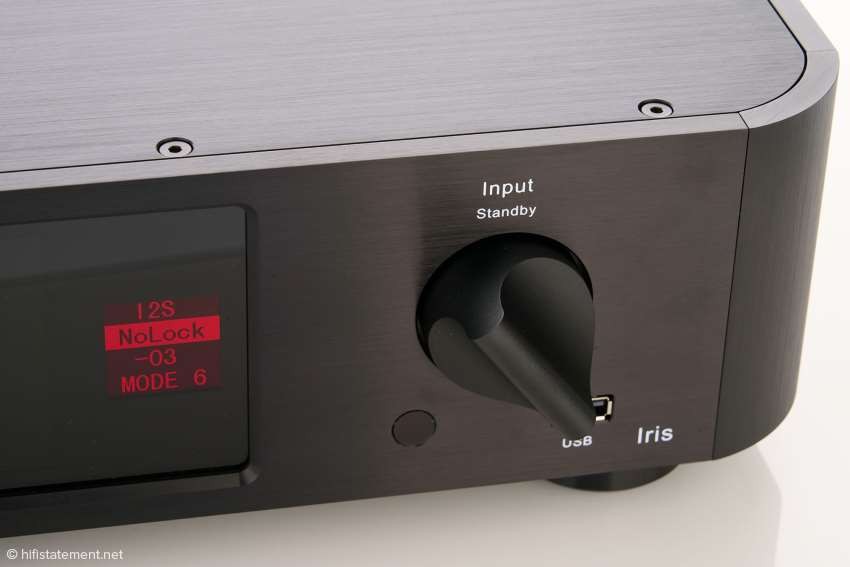
The input selector with the “small” display for visualization
The rear panel shows that the Iris is much more than a simple evolution of its predecessor, the S10 II. On the analog side, there is an unbalanced RCA output and a fully balanced XLR output, although they cannot be operated simultaneously. Two RCA inputs allow the Iris to function as a full-fledged preamplifier.
Ayon has changed its approach to the digital inputs. The S10 II’s USB Type-B port for direct computer connection has been eliminated. Given the Iris’s consistent focus on network streaming, this seems logical. Anyone already sending music over the network does not necessarily need a second, parallel USB connection. An additional USB transmission path would be largely redundant within this concept. Whether Gerhard Hirt’s reservations about USB, which he has expressed to me, also played a role remains an open question.
In return, two interfaces that were missing from the S10 II, but had previously appeared on the earlier S3, have returned: AES/EBU via XLR and I²S via HDMI. Both inputs provide interesting connection options, particularly for high-quality CD and SACD players.
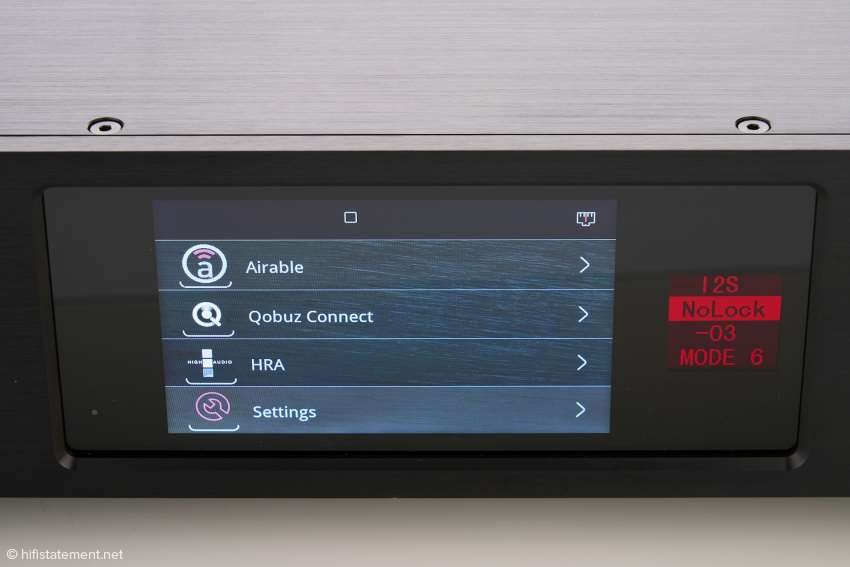
The large, exceptionally easy-to-read display
The I²S input is particularly interesting because there is no uniform standard for this interface when connecting external devices. Signal pin assignments can vary from manufacturer to manufacturer, sometimes making it challenging to combine equipment from different brands.
Ayon addresses this problem elegantly: the I²S interface can be flexibly configured via the app, allowing it to be adapted to the particular source component. This makes it exceptionally versatile.
A coaxial S/PDIF input via RCA and a TOSLINK connection are also provided. The two USB Type-A ports on the front and rear for directly connecting USB storage devices remain unchanged. Network connectivity is available via wired RJ45 Ethernet or wireless Wi-Fi. The Iris is therefore extremely well equipped for its primary purpose: network-based music playback. Finally, a coaxial S/PDIF output allows connection to a digital recorder or external D/A converter.
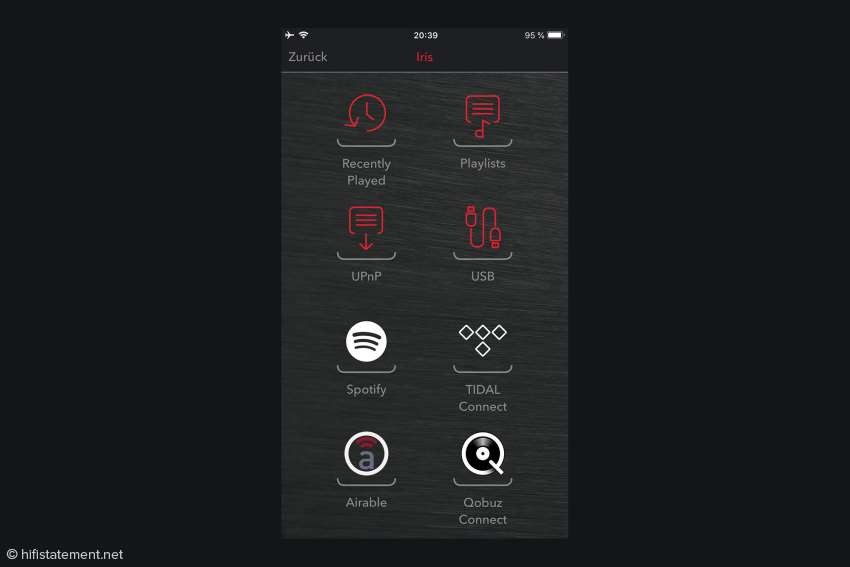
The Iris can be conveniently configured and controlled using Ayon’s own app
Looking at the S3, S10 and Iris reveals an interesting evolution. Some interfaces were eliminated along the way and have now returned, while USB-B has finally given way to a design more strongly focused on network streaming.
One constant remains: the streaming unit continues to come from Austrian specialist StreamUnlimited, with whom Ayon has successfully collaborated for many years. Gerhard Hirt openly acknowledges that it would be difficult for Ayon to keep pace with the rapid development in this field entirely on its own.
Accordingly, the Iris is fully up to date: Tidal Connect, Qobuz Connect and Spotify HiFi Connect can be used directly from their respective apps. Compared with the older app infrastructure of the S10 II, this represents a significant improvement in convenience.
The “Settings” menu with its extensive configuration options
At the heart of the digital signal processing are two AKM 4493 converters from Asahi Kasei Microdevices in a dual-mono configuration. Each channel therefore has its own dedicated converter.
Support for various PCM and DSD formats has become an expected capability of a modern D/A converter. What happens after the actual converter chips is more interesting. The low-pass filter has been fundamentally redesigned, with particular attention paid to achieving an optimal interface with the subsequent analog tube stage. The low-pass filter performs a crucial role in the overall design: it forms the bridge between the digital and analog worlds.
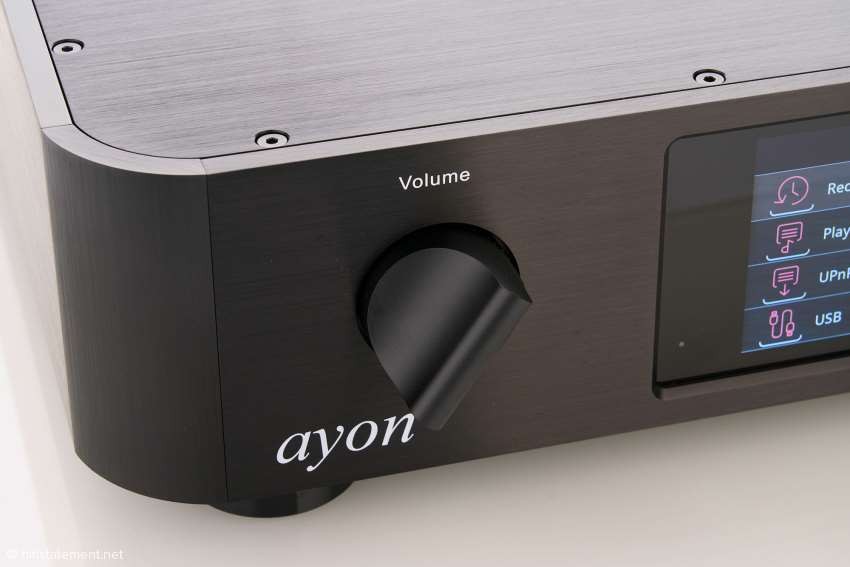
The large stepped volume control
Ayon also takes its own approach to volume control. The digital level control integrated into the AKM 4493 is not used. Instead, level adjustment is handled by a fully balanced analog circuit using the high-quality PGA 2320 chip. Volume is controlled through a resistor network directly in the analog signal path.
What is remarkable is how seamlessly this analog volume control has been integrated into the Iris’s modern operating concept. Volume can, of course, be adjusted using the supplied remote control, but it can also be controlled while streaming through the Ayon app on a smartphone or tablet.
Even more elegantly, this functionality is not limited to Ayon’s own application. Third-party apps such as JPLAY iOS can also use this function. The corresponding control information is passed from the streaming platform through an interface to the PGA 2320’s control electronics.
Anyone connecting the Iris to an external preamplifier can also remove the volume control completely from the signal path.
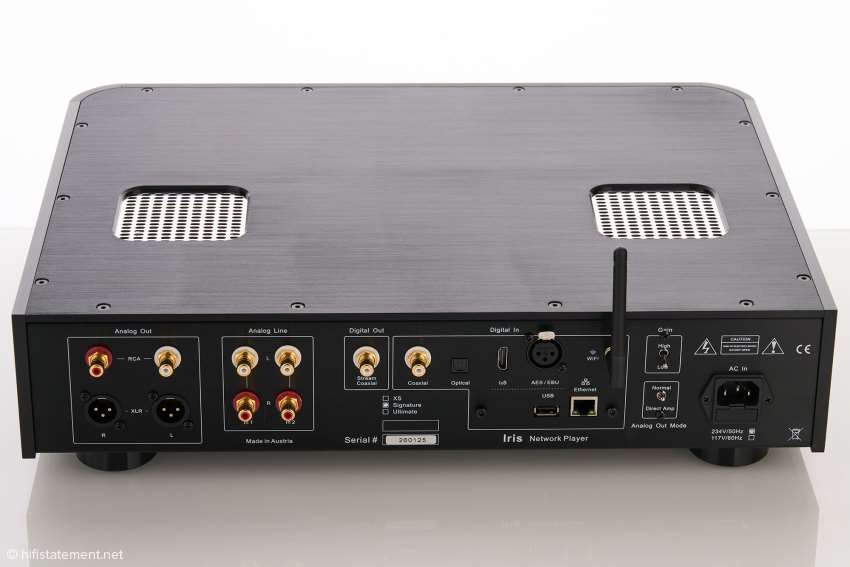
The extensive connection panel leaves little to be desired
Ayon has always paid particular attention to the analog output stage. The company deliberately follows a minimalist approach: few components, but of very high quality, combined with the shortest possible signal path.
At its heart is a 6H30 dual triode operating in a single-ended Class A circuit with no voltage negative feedback. The balanced outputs each have their own fully balanced signal path.
Compared with the S10 II, the tube stage has been further refined. One new feature is separate heater-voltage regulation for each tube, keeping the left and right channels completely independent even at this stage.
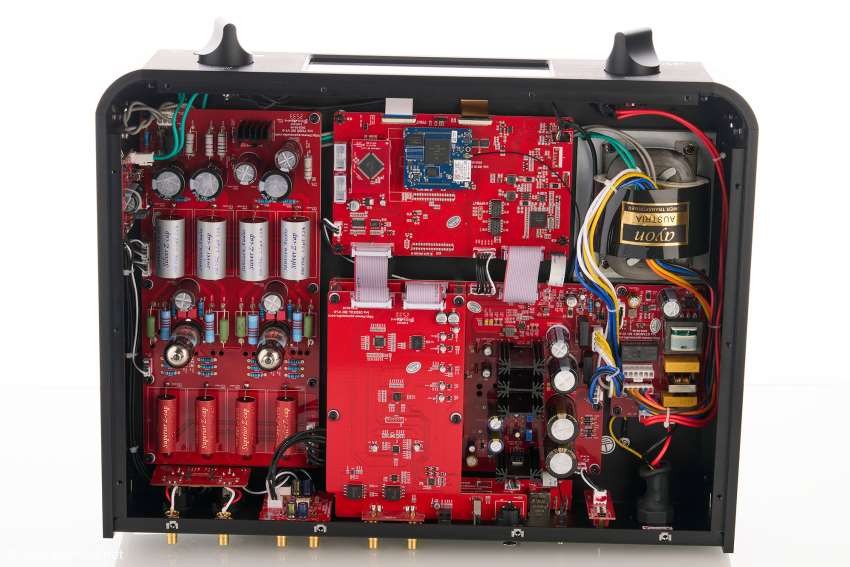
For component selection, Ayon uses high-quality audiophile parts, including Jantzen coupling capacitors and tightly toleranced MKP film capacitors.
Anyone intending to connect the Iris directly to a power amplifier should make sure that the amplifier’s input impedance is not extremely low.
The Iris from the inside. The modular construction is clearly visible: the analog tube amplification stage is on the left, the streaming unit is at the upper center with the digital input module beneath it, and the power supply is on the right.
The considerable effort devoted to the signal path continues into the power supply. Improved filtering at the AC input helps prevent unwanted interference from entering the unit. A powerful R-core transformer supplies the digital and analog sections through separate windings.
Generously sized filter capacitors and a total of eight voltage regulators provide stable operating conditions and reduce interaction between the individual circuit sections.
The Iris is completely modular and can be upgraded at any time. The entry-level model is the Iris XS, featuring a 6N6 tube, simpler component selection and no DSD converter module.
The Signature version incorporates particularly high-quality coupling capacitors in the analog section as well as different tubes. My review unit, for example, is equipped with Jantzen Silver Z-Cap and Jantzen Superior Z-Cap capacitors and 6H30PI-EB tubes.
The Ultimate version takes component quality another step further with Mundorf Silver/Gold/Oil capacitors and specially selected 6H30 tubes.
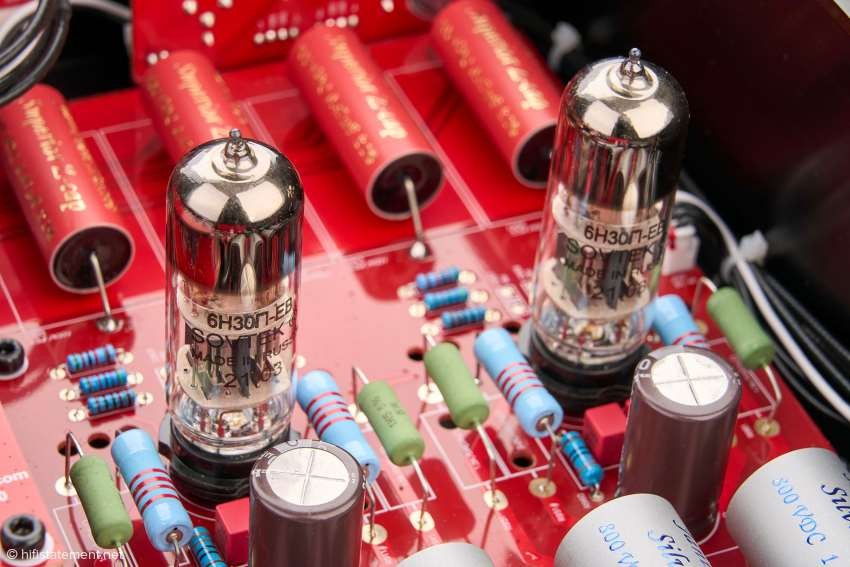
The familiar 6H30 dual triode in the analog amplification stage
Another special feature of the higher-end versions is the DSD converter module. Using DSP, it can optionally convert incoming PCM signals to DSD64, DSD128, DSD256 or DSD512. Native DSD signals bypass the module unchanged.
The conversion algorithm used remains an Ayon trade secret. The module was developed jointly with StreamUnlimited and other specialists in digital audio technology.
How convincingly this concept has been implemented, and how the numerous changes actually affect the sound, can ultimately only be determined through listening.
So it is time to leave the technical specifications and conversations with Gerhard Hirt behind and put the Iris where its qualities can be experienced most directly: in my system.
For this purpose, the Iris is connected via LAN to my network through my SOtM switch. Music comes either from the internal hard drive of my SOtM Audio PC or directly from Qobuz. The Audio PC and switch receive their clock signal from the SOtM 10-megahertz clock. The entire setup is controlled using the JPLAY iOS app. On the analog side, the Iris connects directly to my Stax DA-80M Class A monoblock power amplifiers.
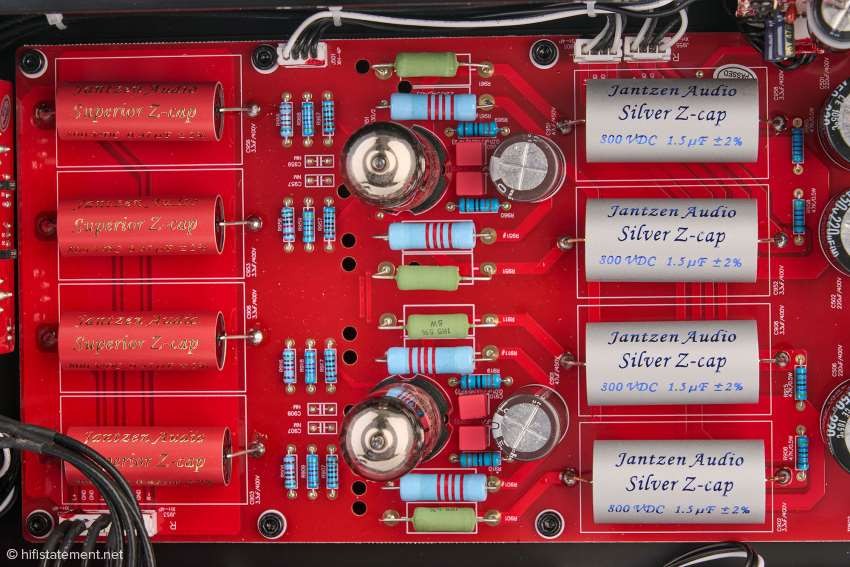
The complete analog amplification stage with high-quality Jantzen Silver Z-Cap and Jantzen Superior Z-Cap coupling capacitors
From the very first notes, one thing becomes clear: sonically, the Iris is anything but a typical example of supposedly “warm” tube sound. Its 6H30 output stage sounds neither soft nor romanticized, but exceptionally precise and transparent while remaining remarkably natural.
I begin with Michael Jackson’s classic “Billie Jean” (Thriller – Qobuz 24/176). The opening bass lines immediately demonstrate that the Iris is anything but restrained in the low frequencies. The bass is powerful, dry and cleanly defined.
What matters here is less the amount of bass energy than the degree of control. Every impulse is precise and remains clearly defined even at higher volume levels. The Iris allows the bass to do its job without unnecessarily pushing it into the foreground.
The Iris finds its true strength in the midrange. Patricia Barber’s “What A Shame” (Café Blue – Qobuz 16/44), a classic among audiophile jazz recordings, impressively demonstrates how naturally the Iris places voices within the soundstage.
Patricia Barber’s voice has body and exceptional clarity. The finest nuances of articulation are effortlessly reproduced without creating an artificial sense of presence.
This strength becomes even more impressive with Rebecca Pidgeon’s “Spanish Harlem” (The Raven – Qobuz 16/44). Both the track and album come from the Chesky Records environment, known for excellent sound quality.
Pidgeon’s voice does not simply appear between the loudspeakers; it seems physically present in the room. At the same time, the acoustic environment of the recording remains remarkably easy to perceive. Here the Iris combines fine detail resolution with an exceptionally natural and tangible presentation.
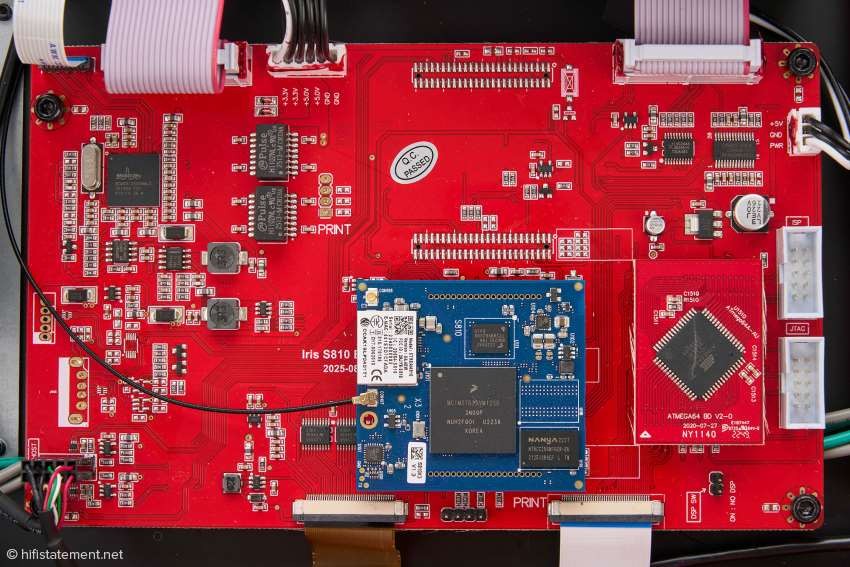
The digital section in detail, with the StreamUnlimited streaming module in blue at the center
The successful tuning is equally apparent in the high frequencies. With Dave Brubeck’s “Take Five” (Take Five – Qobuz 16/44), brushwork and cymbals are finely differentiated, with attacks and decays reproduced precisely.
Remarkably, this high level of resolution never sounds analytical or sharp. The Iris plays openly and with abundant detail while remaining pleasantly smooth.
A fine example of how effectively the Iris combines all these characteristics into a cohesive whole is Nils Lofgren’s “Keith Don’t Go (Live)” (Acoustic Live – Qobuz 16/44). The acoustic guitar has impressive presence while the many subtle details of the live recording remain intact: fingers sliding across strings, tapping on the guitar body and the echo of the concert hall extending far behind the loudspeakers.
None of this sounds exaggerated or artificially spectacular. Instead, the Iris conveys an exceptionally convincing impression of space and live atmosphere.
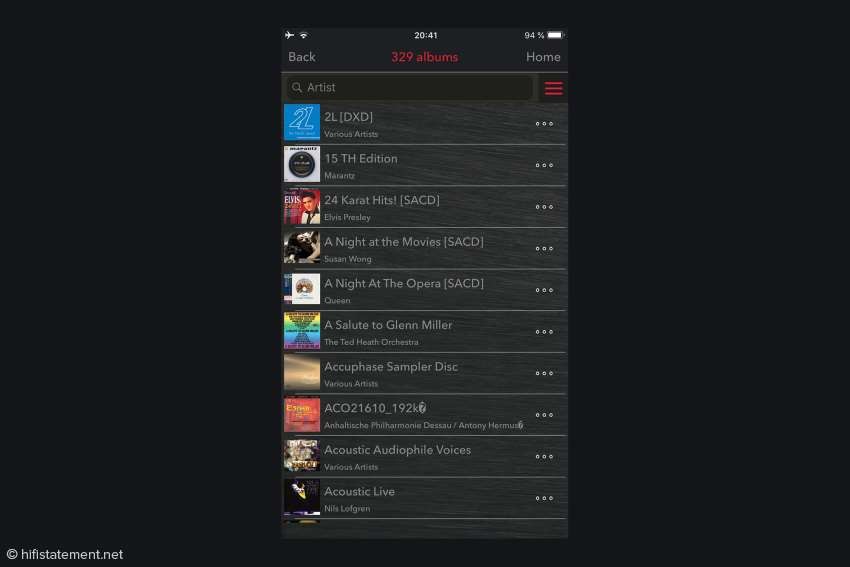
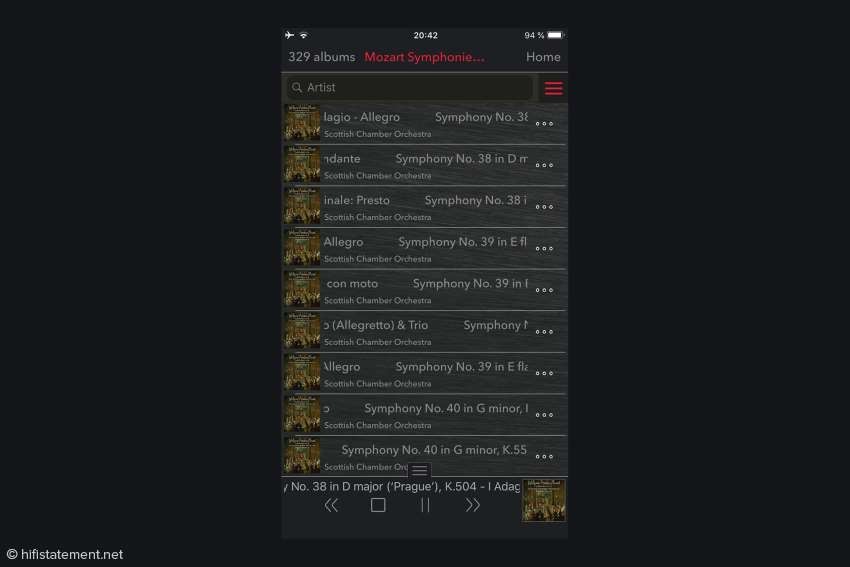
Album view in the Ayon app
I was particularly impressed by the quality of the spatial presentation with good orchestral recordings.
Over many years of collaboration, Charles Mackerras and the Scottish Chamber Orchestra developed a distinctive and highly successful style combining the best aspects of modern and historically informed performance practice.
The outstanding recordings of Mozart’s final four symphonies (Mozart: Symphonies Nos. 38–41 – SCO/Mackerras – Linn Records 24/88) demonstrate just how effective this combination can be.
The recording, which is also excellent from a sonic standpoint, demands dynamics, clarity and convincing depth layering. This is precisely where the Iris shines.
It presents the orchestra with substantial depth and believable layering, extending far behind the loudspeakers into an imaginary acoustic space without attempting to impress through an artificially inflated soundstage. Combined with its pronounced sense of physical presence, the result is an exceptionally realistic, three-dimensional impression.
Another intriguing capability of the Iris is its option to convert PCM material to DSD using DSP. I find this particularly appealing when streaming CD-quality material, for example from Qobuz.
For me, the question is less whether DSD inherently sounds better than PCM and more about which version best suits personal taste and the particular recording.
Player view with the selected track in the Ayon app
With Mozart’s Violin Concerto No. 3, featuring Iona Brown as soloist with the Academy of St. Martin in the Fields (Mozart: Violin Concertos Nos. 3 & 4 – Qobuz 16/44), DSD128 conversion gives the reproduction, to my ears, greater smoothness and brilliance.
The solo violin sounds less strained in its upper register while simultaneously gaining more natural radiance and intensity. At the same time, the orchestral presentation gains noticeably greater spatial depth.
Direct PCM playback, on the other hand, sounds to me slightly more detailed and immediate.
With DSD256 and DSD512, the character increasingly moves away from the original PCM presentation. Playback remains smooth and gains still more spatial depth, but to my ears it also becomes more compact and loses some immediacy and detail.
DSD128 is therefore my personal sweet spot. Particularly with streamed CD-quality material, this setting can give the sound that certain extra something.
STATEMENT
The Ayon Iris impresses sonically in every respect while simultaneously proving itself to be an outstanding and versatile streaming player. An unreserved recommendation for demanding music lovers!
Associated Equipment
Computer
SOtM Audio PC with sMB-Q370 motherboard, sCLK-EX clock module and tX USB module
Music server with Intel Xeon E3-1225 3.2 GHz, 4 GB RAM, Windows Server 2019 with AudiophileOptimizer 3.0, HDPLEX 400W ATX linear power supply and HDPLEX 200W linear power supply
Diretta Lucia Piccolo Bridge, LattePanda Alpha 864s with Intel 8th-generation m3
Diretta Target Bridge and HDPLEX 200W linear power supply
Software
JPLAY iOS App, MinimServer, JPLAY Femto, JPLAY femtoServer, Roon Server
10 MHz Clock
SOtM SCLK-OCX10
USB
SOtM USB Hub tX-USBultra, MUTEC MC-3+ USB
Preamplifier
Erno Borbely
Power Amplifier
Stax DA-80M
Cables and Accessories
AIM NA9, NA6, JCAT Reference USB, JCAT Reference LAN, AudioQuest Pegasus Analog XLR, Van den Hul, Analysis Plus Digital Oval Yellow, AudioQuest Eagle Eye Digital Cable, SOtM dBCL-BNC, AudioQuest Niagara 5000, Sortz RCA, Sortz LAN, Sortz BNC
Manufacturer Specifications
Ayon Iris Signature Streamer
Digital Inputs
75 Ω S/PDIF, TOSLINK, AES/EBU, I²S/HDMI, 2 x USB-A for external storage
Network Inputs
RP-SMA connector for Wi-Fi antenna input (wireless network connection), RJ45/LAN Gigabit Ethernet socket (wired network connection)
Digital Outputs
75 Ω S/PDIF (RCA)
Sample Rate
Up to 768 kHz / 32-bit and DSD512
PCM-to-DSD Conversion
Optional conversion of all PCM signals to DSD64, DSD128, DSD256 or DSD512
Formats
WAV, FLAC, AIF, DSD (DFF, DSF)
Streaming Protocols
Tidal Connect, Qobuz Connect, Spotify HiFi Connect, HiResAudio, Airable Radio & Podcasts, Roon Ready, UPnP/DLNA
Analog Line-Level Inputs
2 pairs RCA
Analog Outputs
1 pair RCA and 1 pair XLR
Weight
12 kg
Dimensions
48 x 36 x 12 cm (W x D x H)
Price
Ayon Iris Signature: €10,995
Ayon Iris XS: €7,995
Ayon Iris Ultimate: €14,995
Manufacturer/Distributor
Ayon Audio
Address
Hart 18
A-8101 Gratkorn
Telephone
+43 3124 24954
Web
Distributor
AUDIUM / VISONIK
Address
Owner: Frank Urban
Catostr. 7B
12109 Berlin
Telephone
+49 30 6134740
Fax
+49 30 7037939
Web